Category Archives: Teaching

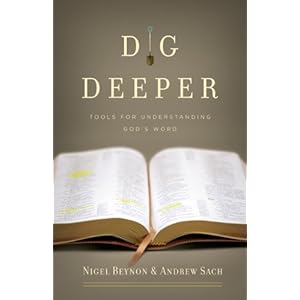
Book review: Dig Deeper

Dig Deeper is truly a gem. It’s one of the best introductions to biblical interpretation I’ve ever read. Written in a fresh, readable style, the authors cover an amazing amount of territory in a very short book.

In the introduction, the authors write, “We want to help you to dig deeper to find hidden riches in the Bible…Pastors and scholars are a gift from God, and we should be grateful for their help. But we shouldn’t be content to leave it entirely to the experts…This book is based on the idea of a toolkit…a set of practical tools to help you get to the bottom of any Bible passage.” They then proceed with 16 different tools, from the Author’s Purpose tool (most important), to the Vocabulary tool; from the Structure tool, to the “So What?” tool.

I’ve heard many people say, “I try to read the Bible, but it’s so hard to understand!” This book could radically improve your Bible study and devotional life. It moves at a rapid pace while not missing weighty concepts. It gives a broad sample of biblical texts and warns of common interpretive errors. One of its greatest strengths is a short exercise at the end of each chapter, and then a brief example of how all the tools work together at the end of the book.

There are two areas that would have made this book even better. First, the authors should have included a full chapter on history and cultural background. They could have called it the “culture tool.” Re-creating the original setting, manners, customs, geography, archaeology, etc. are all a vital part of fully understanding a passage. Secondly, I have to respectfully disagree with their approach to prophecy (p. 107 and 122). They represent a classic covenantal position which misses the unconditional nature of the Abrahamic covenant and departs from the same literal hermeneutic they recommend elsewhere.

But with these 16 practical tools in hand, you can finally dig deeper into God’s Word. Read it. Study it. Enjoy it. And let God radically change your life.

Equipped for Excellence 2010

On Saturday, April 17, the Inland Empire Southern Baptist Association will be hosting their annual Equipped for Excellence conference. This is one of the best discipleship conferences in the country for Sunday School and Small Group training.

This year, I have the privilege of teaching a seminar entitled, “How to Study and Interpret the Bible.” In four and a half hours, you’ll get a crash course in biblical interpretation (hermeneutics) and even get to practice in class what you are learning. The class is designed to help people of all levels, whether you are just doing personal devotional reading or preparing an in-depth Bible Study.

This is just one of many other options. Full conference details are below. Be sure to register by next Monday, April 5, to get your early bird discount!


When: April 17, 2010 – 8:30 a.m. to 3:30 p.m.

Where: Magnolia Avenue Baptist Church and California Baptist University in Riverside , California (map). (Carpooling will be available from First Southern Yucca Valley)

Cost: $40 per person if your registration is postmarked by April 5th. $45 per person if form is postmarked after April 5th. The registration fee includes a continental breakfast, lunch on site by IN-N-OUT BURGER, and five hours of quality Sunday School instruction! Please note that conferees can also have lunch at the Alumni Dining Commons at CBU!

Keynote Speaker: Pastor Calvin R. Wittman of Applewood Baptist Church in Wheat Ridge , Colorado

Conferences Available: Below you’ll find a list of all the conferences offered, or you can view a Word document with the full descriptions.

FOR POTENTIAL TEACHERS

Training Potential Sunday School Workers (Tom Belew)

FOR PRESCHOOL

Babies and 1 & 2 year olds (Lynae Dacus)
Three-Year Olds through Pre-K (Landry Holmes)
Kindergarten (Ann Iorg)
Using Visuals in Teaching (Lorie Honeycutt)
Working With Special Ed (Pamela Robinson)

FOR CHILDREN’S MINSTRY TEACHERS

Younger Children (Carol Bohrer)
Middle Children (Karen Massingill)
Older Children (Judy Latham)
Using Visuals in Teaching (Lorie Honeycutt)
Strengthening Your Children’s Ministry (Cathy Hopkins)
Guiding Children’s Behavior in Sunday School (Cheri Dempsay)
Working With Special Ed (Pamela Robinson)

YOUTH MINISTRY

Junior High (Cheryl Belew)
Senior High (Mike Lovato)
Strengthening Your Youth Ministry (Daryl Watts)
Youth Outreach and Ministry (Mike Kell)
Youth Developmental Characteristics and Teaching Methodology (Rob Signs)
Using Visuals in Teaching (Lorie Honeycutt)
Working With Special Ed (Pamela Robinson)

ADULT MINISTRY

Single Adults (Rick Brady)
Young Adults (Jason Hayes)
Middle Adults (Alan Raughton)
Retired Adults (David Apple)
Care Group Leaders (Janice Holcomb)
Using Visuals in Teaching (Lorie Honeycutt)
Working With Special Ed (Pamela Robinson)

SMALL GROUPS

Small Group Ministry for New Church Starts (Don Overstreet)
Enlistment and Training of Small Group Leaders ( Orlando Alonso)
Dealing with Problems in Your Small Group Ministry (Neil Christopher)

GENERAL LEADERSHIP

Pastor’s Conference (Calvin R. Wittman)
Outreach (Tim Holcomb)
Assimilating New Members (Randy McWhorter)
Pastors & Sunday School Directors (small Sunday Schools) (Larry Vowell)
General Officers (George Yates)
Strengthening Your Children’s Ministry (Cathy Hopkins)
Strengthening Your Youth Ministry (Daryl Watts)
Youth Outreach and Ministry (Mike Kell)
Youth Developmental Characteristics and Teaching Methodology (Rob Signs)

SPECIALTY

Using Visuals in Teaching (Lorie Honeycutt)
How to Study and Interpret the Bible ( Stephen Jones )
The Bible’s Most Fascinating People (R. P. Nettelhorst)
Valuing Volunteers (Katherine Gooden)
Care Group Leaders (Janice Holcomb)
Working with Special Ed (Pamela Robinson)
Guiding Children’s Behavior in Sunday School (Cheri Dempsay)
Leadership in the Transformational Church (Bruce Raley)
Biblical World View (Greg Harris)
The Genesis of Creation (Bill Peters)
500 Lost Years (Richard Mobley)
Making Disciples in Your Adult Sunday School Class (Roger Byrd)
Developing a Strategy Plan for Your Church (Mike McGuffee)
Using Technology in Your Church (Bobby Gilstrap)
The Bad Economy: Your Best Friend (Bruce Hitchcock)

Faith in the Famine

The last couple Sundays, we’ve been meeting some of the Minor Prophets of the Old Testament. (These men, of course, are not considered “minor” because they are any less important than the Major Prophets, but because their books are much shorter. The terms “minor” and “major” were foreign in the Hebrew Bible and Septuagint, and didn’t arrive on the scene until Augustine and the Latin church.)

Two weeks ago, we were introduced to Haggai and Zechariah, a “tag team” commissioned by God around 520 BC to spur on Israel and its leaders to rebuild the temple after the Babylonian exile. We were reminded that joyful obedience to the commands of God comes “not by might, nor by power, but by My Spirit” (Zech. 4:6).

Then, last Sunday, we turned over to the prophet Habakkuk, who ministered almost a century earlier, before the temple had been destroyed. When Habakkuk grieved over the sin of Israel (Hab. 1:1-4), God told him He was going to use Babylon to discipline His people (Hab. 1:5-11). This came as a total shock to Habakkuk, who couldn’t imagine how a holy God could possibly allow an even more wicked people to “swallow up” God’s chosen people (Hab. 1:12-2:3)! God then reassured Habakkuk that the righteous would endure by faith (Hab. 2:4), and that Babylon too would be severely humbled — as soon as they completed God’s assignment (Hab. 2:5-20). Habakkuk closes the short book with a song describing God’s glorious appearance (Hab. 3:1-15) and a commitment to trust in God no matter what (Hab. 3:16-19).

Last Sunday, we focused on the final four verses of the book. We noticed three points:

  1. The prophet’s fear (Hab. 3:16). Habakkuk staggered as he saw the vision of God (vv. 1-15) and considered the full weight of the judgment that was about to land upon Judah. But he resolved to wait quietly for whatever trials the Lord had prepared.
  2. The nation’s famine (Hab. 3:17). God was about to devastate Israel not only with an invading army, but with a severe famine. Things would gradually worsen as figs, grapes, olives, grain, flocks, and cattle all died. Habakkuk paints a bleak picture, but doesn’t stop to worry. He immediately takes these concerns and says, in spite of it all, “I will trust in God!”
  3. The prophet’s faith (Hab. 3:18-19). Here we have a dramatic shift in tone, to one of triumph, victory, safety, and joy. God becomes the focus, rather than Habakkuk’s circumstances. Just like a deer or a bighorn sheep, we are kept safe in dangerous places. We can “rejoice in the God of our salvation” even in life’s darkest moments.

Questions for thought and discussion:

  • The name “Habakkuk” means “one who embraces.” Why is that significant in this book?
  • Have you ever “trembled” inwardly like Habakkuk (3:16)? When?
  • What are your greatest fears in life?
  • What are your greatest physical, financial, and spiritual difficulties?
  • Try re-writing verses 17-18 in your own words, inserting trials that you have or could face

The last two week’s sermons have been uploaded to our  podcast site and are available for free download.

Photo credit: brtsergio

Which came first — the love or the forgiveness?

I recently received this question about Luke 7:47 from a student in our Greek class,

I know this is a bit beyond where we’re at but its there away to tell from the Greek if her love or being forgiven came first? “Therefore, I tell you, her many sins have been forgiven—for she loved much. But he who has been forgiven little loves little.”

There are a few questions that may help us answer this question:

1. What are the verb tenses? Do these tip us off to the timing?
2. What is the meaning of the conjunction “for”?
3. What seems to be the logic of Jesus’ statement?

To answer question 1, we would definitely be getting ahead of ourselves in our Greek class, but the short answer is – there is nothing I can see that dictates that love came after or before the forgiveness. “Loved” is a simple, aorist verb that is undefined in time; it is just a generic past tense idea.

Regarding question 2, the Greek word is “oti” (or “hoti” with the rough breathing mark). Mounce defines this conjunction as “that, since, because.” This might suggest the woman was forgiven BECAUSE she loved God so much. Most translations simply say “for.”

However, notice these two translations:

Holman Christian Standard Bible Luke 7:47 Therefore I tell you, her many sins have been forgiven; THAT’S WHY she loved much. But the one who is forgiven little, loves little.

NET Bible Luke 7:47 Therefore I tell you, her sins, which were many, are forgiven, THUS she loved much; but the one who is forgiven little loves little.

These two translations see her love as the RESULT rather than the CAUSE. This is one legitimate use of “hoti.” Daniel Wallace in his Greek Grammar Beyond the Basics says this about result conjunctions: “This use gives the outcome or consequence of an action. The focus is on the outcome of the action rather than on its intention. Major conjunctions used this way are: ὥστε, ὡς, ὅτι, and less frequently, ἵνα. This use can be translated that, so that, or with the result that. By far the most common is ὥστε.”

When we come to question 3 (Jesus’ logic), I think the idea clearly is that the woman kissed and anointed Jesus’ feet BECAUSE she loved Him so much, and she loved Him so much BECAUSE she knew her many sins had been forgiven by God.

Thus, from both a logical and a grammatical standpoint, it seems best to see love as the result to forgiveness. May all of us be equally grateful to Christ for the forgiveness He bought for us with His blood.

Life Groups

“I like the discussion, the fellowship, working together to think through a passage of the Bible.” 

“I like the give and take…pushing the study in a direction.”
“Life Groups teach us to watch what we say – to be more compassionate to others – Christian or other people.”
“Rotating teachers give a different perspective each week. Sitting around a table was good.”
These are some of the comments people are making about our Sunday Morning Life Groups. We encourage you to join us this Sunday at 9:15 to get into the Word and build deeper relationships with others in the church. You’re already coming for the worship service. Why not arrive just one hour earlier and get some great life-on-life discipleship?
Here’s a new promo video on why you should be attending one of our Life Groups at First Southern. Hope to see you Sunday!