
Category Archives: Teaching

Dead man walking

Last Sunday, we began a “behind the scenes” look at our salvation. We are considering how a person comes to Christ, and what role God plays in this dramatic event. The best place to begin is with the condition of the unbeliever apart from Christ. So we studied Ephesians 2:1-3 and discovered three points:

1. The Condition (Ephesians 2:1-2). The Bible says quite bluntly that we are “dead” without Christ. Because of our sin nature, there is absolutely no life in us. Other passages describe us as spiritually blind, deaf, enslaved, and in rebellion, and totally unable to please God (Romans 8:6-8).

2. The Consequence (Ephesians 2:3). The result of this terrible condition is that we are all under God’s wrath. We rightly deserve eternal torment in hell because of the heinous nature of our crime against God.

3. The Challenge. Here’s the dilemma. We are spiritually dead and racing down the broad road to hell. And there’s absolutely nothing we can do to fix the situation. Nothing. (We’re dead, remember). We cannot change our hearts any more than an Ethiopian can change his skin, or a leopard can remove his spots (Jeremiah 13:23). But here’s the good news: What is impossible for man is possible for God! By sending His Son, God has redeemed us and made us alive in Christ! (Ephesians 2:4-9).

Questions for thought and discussion:

• What does it mean that I am “dead in my trespasses and sins”?
• Do our “good works” earn favor with God? Why or why not?
• Have I trusted in Christ alone for forgiveness and eternal life?
• Read 1 Corinthians 2:4. Can our clever techniques ever draw an unbeliever to Christ?
• If Ephesians 2:2-3 depicts the lifestyle of an unbeliever, how could we describe the lifestyle of a believer?
• Write out a prayer of thanksgiving for what God has rescued you from, and what He has done for you.

Sunday’s sermon has been posted to our podcast site and is now available for free download.
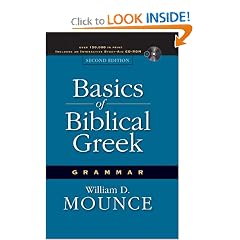
Book review: Basics of Biblical Greek Grammar

Basics of Biblical Greek Grammar by William Mounce is the best beginning Biblical Greek grammar available today.

After introducing the Greek alphabet and word structure, Mounce helps students gain a solid control of Greek nouns (ch. 5-14). He then moves on to indicative mood verbs (chs. 15-25) followed by participles, non-indicative mood, and other troublesome verbs (chs. 26-35). The appendix itself, full of charts and paradigms, is worth its weight in gold.

I’m currently teaching a beginning Greek class with about 15 lay people at our church using the 2nd edition textbook. Mounce is such a clear teacher that any student with self-discipline could actually teach himself the language. Using Mounce’s Greek Workbook and Flachcards (each sold separately), you can practice exercises and review vocabulary that reinforce each chapter. The author also provides an alternate track for those who want to introduce verbs earlier in the learning process. Other benefits include a CD-ROM, links to Mounce’s website, and cross references to his Morphology book and Wallace’s intermediate Grammar for those who want to dig deeper into the language. If there are any drawbacks, it would be an underemphasis on accenting and linguistics.

Please note: there is now a Third Edition of this text available as of December 2009. You will have to decide if you want to buy the second or third edition. The third edition employs more white space in the margins, new pictures, color shades, and book dimensions that are about 30% larger. It now looks more like a Jr. or Sr. High language textbook. The new book also has the benefit of laying open flat on your desk without pages being tempted to flip closed. Apart from the new “look” and size and a few new features, content in the 3rd edition is largely unchanged from the second edition. To learn about the specific differences between the second and third edition, click here.

Frogs, and hail, and locusts, oh my!

Have you ever wondered what it was like to live through the plagues of the Exodus? Take Exodus 10, for example. Here we have a locust plague so devastating that the insects “covered the surface of the whole land, so that the land was darkened; and they ate every plant of the land and all the fruit of the trees that the hail had left. Thus nothing green was left on tree or plant…” (Ex. 10:15). God’s judgment on Pharaoh was very severe.

But they’re just cute little bugs, right? Um, no. One or two grasshoppers on the front lawn might be fun to watch and pick up, but multiply them by millions and millions, and you have sheer destruction. Nearly a hundred years ago, a modern version of this story took place. In 1915, millions of locusts swarmed through Palestine, devastating crops and attacking people. Just listen to this description:

Whenever touched, or especially when finding themselves caught within one’s clothes, they exuded from their mouth a dark fluid, an irritant to the skin and soiling the garments in a most disgusting manner. Imagine the feeling (we speak from experience) with a dozen or two such creatures over an inch long, with sawlike legs and rough bodies, making a race-course of your back!

Check out a couple amazing pictures of the locust plague at Todd Bolen’s site here.

Photos of Bible manners and customs

This looks like an outstanding resource, announced in Todd Bolen’s latest BiblePlaces newsletter…

The Traditional Life and Customs photos…have long defined the entire [American Colony photo] collection for me. When someone would ask what I was working on, I’d smile and tell them about the photos in this set. If nothing else, the American Colony collection had to see the light of day because these were photos that I could never take myself, in any shape or form. With Jerusalem, you can still get a photo of the Kidron Valley, even if it is covered with buildings. But the only fishermen I see today on the Sea of Galilee are in motorboats and they are wearing plastic green coveralls. I have trouble imagining Jesus and the disciples with this picture.

Shepherds still roam the Judean hills with their flocks, but I hesitate to include them in any photo because they’re wearing a windbreaker and Levis. The grain harvest usually includes a combine, and cooking is over an electric stove. When a locust plague threatens, the authorities are quick to react to prevent the insects from devouring the crops. That’s good for the farmers, but bad for the photographers. This new volume has all of this and much more…

Just what does Traditional Life and Customs include?

Agricultural Life: Plowing, Sowing, Water, Vineyards, Locust Plague, Grain Harvest and Olive Harvest (185 photos total)

Biblical Stories: Christmas, Ruth, and Psalm 23 (75 photos total)

Psalm 23:2

Home Life: Food Preparation, Women at Work, and Weddings (100 photos total)

Religious Life: Christian, Jewish, Muslim, and Samaritan (110 photos total)

Work Life: Clothes Making, Fishing, Pottery Making, Shepherds, Trades, and Travel (150 photos total)

Quotations: We have scoured the reports of travelers in the 19th century for the most interesting and helpful descriptions of these scenes. Even if you didn’t have the photos, your understanding and appreciation for traditional ways would be greatly increased by these quotations!

We dare you not to love this collection. (Note: We are not easily excited.)

You can purchase it online for $20, with free shipping in the US.

Want to learn Greek?

I’ve had a few people at church ask recently about learning Biblical Greek together, and I would like to find out who is genuinely interested in this.

It doesn’t matter where you live. Whether you live right down the street or across the world, anyone could potentially join us.

Greek is a vivid and precise language that gives great insight into the grammar and meaning of the New Testament. It’s a challenging language, but well worth the effort.

I have taken five semesters of Greek and use it regularly in my sermon prep, so while I’m no expert, I would love to share what the Lord has taught me up to now, and am confident that teaching it to others would stretch and sharpen my own skills.

I’m considering starting a class in January 2010 with a “blended” format of lecture, homework, and online discussion:

  • Our main textbook would be Bill Mounce’s Basics of Biblical Greek and the accompanying workbook
  • We could meet twice a month on Tuesday nights from 6:30-8:30 pm. Each student would have the option of attending class at church, or staying at home and video-conferencing with us via the free online service Skype.
  • Students would also participate in weekly discussion topics using Google Groups. It is a very easy-to-use website, and I have already created a tentative group for our class.

Please leave a comment below if you’re interested.