Category Archives: Teaching

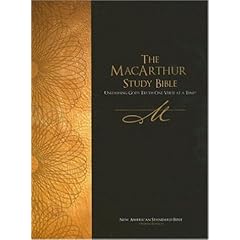
Half off MacArthur study Bibles

Today only, Monergism is offering all New American Standard MacArthur Study Bibles at a 50% discount.

If you don’t own one yet, today’s the perfect opportunity to get one for yourself. Or, why not do some super-early Christmas shopping and get one for a friend?

I believe the MacArthur Study Bible, along with the ESV Study Bible, should be on every Christian’s bookshelf. Both of these tools offer a wealth of Biblical information, and much of their content does not overlap.

HT: Tim Challies

A Bible for every age and reading level

As a follow-up to yesterday’s post on daily Bible reading, I think it would be good to say something about Bible translations.

Personally, I prefer reading from my New American Standard Bible, but I would not recommend everyone to jump right into this version. For some readers, its heavy, literal style would feel awkward and wooden, and might actually discourage daily Bible reading.

If someone is younger, or relatively new to reading the Bible, I would encourage them to start with a more readable translation, then gradually work toward a more literal, advanced-level translation.

Here’s a recommended list of English Bible translations for every age level:

Young children:
The Jesus Storybook Bible
The Big Picture Story Bible
(We started using these Bibles even before our children were a year old. We love using them for family devotions!)

Beginning readers:
Egermeier’s Bible Story Book
NIV Adventure Bible

Intermediate readers:
New International Version
The New King James Version
(both considered 7th grade reading level)

Adult level readers:
English Standard Version (around an 8th grade reading level)
New American Standard Bible (10th grade reading level)

It’s not that there’s anything super-spiritual about reading a Bible that is more advanced. God always intended the Bible to be read by the common people. In fact, He chose for the New Testament to be written in the koine, i.e. common, Greek instead of the more sophisticated classical style Greek.

Nevertheless, I believe that “formal equivalent” translations like the ESV and NASB best reflect the original languages of the Old and New Testament, and thus are most accurate for in-depth Bible Study. When I read these translations, I feel confident I’m hearing God speak with the words and grammatical emphases He intended. It’s the next-best thing to reading from the original languages.

December 2010 Update: I’m becoming more impressed with the Holman Christian Standard Bible (HCSB), and have been giving it a “test drive” from the pulpit this month. With the Apologetics Study Bible, HCSB Study Bible, and a 2009 revision, I believe this translation has really matured and gone more mainstream. Here’s a paper by Dr. Bill Barrick showing the exegetical accuracy of the HCSB. 

October 2011 Update: After sixteen years with the NASB and another year trying out the Holman Bible, I’ve made a permanent change to the ESV for personal Bible reading and our ministry at First Southern Baptist Church. This was not an easy decision, but the ESV is a great translation and has tons of study resources available. Click here to read more reasons I made the switch.

May 2024 Update: I continue to read and preach mainly out of the ESV. Having recently taken a pastorate at Calvary Church West Hills, I’m still learning which translations are most familiar to my congregation, and what will be best moving forward. I have updated a couple recommendations and links in this article since some availability has changed since the time of writing. Some Amazon affilitate links are in this article.

Photo credit: univrsltransl8r

Daily devotions

I highly recommend for everyone to read through the Bible in a daily, systematic way so they will be exposed to the “whole council of God” (Ac. 20:27).

One of the greatest ways to do this is to follow one of the many “Bible in a year” reading plans. I personally like this one produced by Discipleship Journal.

Someone recently asked me how to balance between daily Bible reading and more in-depth, personal study of God’s Word. Here’s their question:

“How do you balance between the yearly reading plan that the church is doing and your own personal studies? I’m trying to do a daily devotional, which is only a couple of minutes, and read through the Bible in chronological order this year. They both are only a few minutes a piece, but they seem to be conflicting.”

Here was my response:

Great question. I don’t have a simple answer for this. It’s something that I struggle with also. But here are a few suggestions:

1. Try to integrate your personal study into your yearly reading plan. I’m trying to do this in 2009. I want to learn more about the theology of suffering. So, each day, I’m reading the Bible with particular interest in anything the Bible has to say about suffering and how believers should pray and respond. I am recording short prayers in my journal that reflect what I’m learning.

2. Have separate times for chronological reading and devotional reading. Maybe read your devotional book in the morning, and your yearly reading plan on lunch break, or in the evening at home.

3. If you follow the Discipleship Journal reading schedule, you have one day per week you could use for personal study, along with a couple extra days at the end of the month. I must admit I usually need that extra day of the week just to catch up on any reading that I am behind, so this system would not work very well for me personally.

4. Alternate your yearly reading plan with in-depth study. Try reading the whole Bible in two years instead of one, and then alternate each month between in-depth study and your chronological reading of Scripture.

I believe reading the whole Bible is important, since “Scripture interprets Scripture” and context is the #1 rule of Biblical interpretation. However, it is good to pause regularly to look at the individual “trees” and not just the big “forest.”

Hope this helps a little. I praise God for your passion for His Word!

Photo credit: House of Sims

The high priest’s rope

You’ve probably heard about the rope the high priest would wear each year when he would enter the Holy of Holies. Well, the whole thing is probably a myth that originated in the Middle Ages and was perpetuated by commentators like John Gill.

Todd Bolen writes,

The notion that the high priest would tie a rope around his ankle before entering the Holy of Holies on Yom Kippur (the Day of Atonement) so that his body could be pulled out should he be struck down is not found in any ancient source, including the Hebrew Bible, the New Testament, the Dead Sea Scrolls, Josephus, the Apocrypha, the Mishnah, the Babylonian Talmud, or the Jerusalem Talmud.

Still not convinced? You can read the whole thing here.

Oh well, it was a good story, anyway.