
Saved by the Spirit

Having already looked the past couple weeks at the role of the Father and the Son in our salvation, we turned our attention last Sunday morning to the role of the Holy Spirit.

God the Holy Spirit was instrumental in the creation of the universe (Gen. 2:2), the inspiration of the Scriptures (2 Pet. 1:21), the virgin birth of Christ (Matt. 1:18), His public ministry (Matt. 3:16), and the resurrection (Rom. Rom. 1:4). But the Holy Spirit was also deeply involved in our salvation. In fact, without His miraculous, transforming work in our hearts, none of us could have been saved. Using Titus 3:5-6 as our main text, we studied the Spirit’s work from two angles:

  1. There is a complete change. Paul’s phrase in v. 5, “washing of regeneration,” pictures a dramatic rebirth, a divinely wrought change in our nature that produces a spiritual “bath.” Simultaneously, there was a “renewing” that took place, meaning we were completely revived and transformed. This was not a mere remodel of our nature with a few cosmetic changes. It was a complete rebuilding. As the early church father John Chrysostom said, “For as when a house is in a ruinous state no one places props under it, nor makes any addition to the old building, but pulls it down to its foundations, and rebuilds it anew; so in our case, God has not repaired us, but has made us anew.” This change, which took place solely by the mercy and kindness of God, is what suddenly caused us to desire faith and repentance.
  2. There is a compelling call. The Bible also speaks of the Spirit’s work in salvation as a “call” upon our hearts. Sometimes, the Bible speaks of a “general call” made freely to all who hear the preaching of the Word (Matt. 22:14). But the call we are speaking of here is a special, inward call (Rom. 1:6-7; 9:23-24). This call is not an audible voice, but a divine tugging upon our heart. It is God the Spirit drawing us and wooing us and reeling us in to Himself. This call is directly linked to our election (Rom. 8:29-30), and is just as powerful and irresistible as when the Creator rebuked the waves (Mk. 4:39) and raised the dead (John 11:43).

Questions for thought and discussion:

  • How is the Father involved in our salvation? The Son? The Holy Spirit?
  • Why do you think there is so little emphasis on the Holy Spirit today among many Christians?
  • Read 2 Corinthians 5:17. Do you see evidence of this transformation in your life?
  • Does regeneration mean we are now perfect and free from sin? cf. Rom. 6:12-18.
  • What’s the difference between the “general call” and “special call” of God?
  • Write a prayer to the Holy Spirit, thanking Him for the work He has accomplished in your heart.

Sunday’s sermon is now available for free audio download from our podcast site.
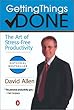
Book Review: Getting Things Done

Does your life feel disorganized? Is your inbox overflowing and office growing more and more cluttered? Do you tend to put things off until the very last minute? Do you feel like your schedule is dictated by the tyranny of the urgent? Then take the time to read Getting Things Done: The Art of Stress-Free Productivity. It may literally change your life.

Early on, Allen gives a five-step process to getting control of your life. First, he says to collect every single item or ‘open loop’ in life that commands your attention and is sapping your energy. Second, begin to systematically process what each item means and what to do about it. Third, go deeper by organizing the results. Fourth, regularly review the progress you are making and re-negotiate your priorities. Fifth, go and do it!

The rest of the book unpacks these five principles with many helpful step-by-step instructions and examples. One thing can be said about David Allen: he takes nothing for granted. He doesn’t just tell you; he shows you. He knows that by the time you pick up his book you may already be overwhelmed and on the brink of burnout. He is patient and walks you through the entire process. It’s like having a personal productivity coach

Probably the most helpful summary of the system is found on page 36, where Allen captures the whole process in graphic form. At first, this workflow chart (which you can view here) may resemble an engineering schematic, but it’s actually a streamlined concept that can be adapted to any profession, from stay at home mom to Fortune 500 CEO.

Though I would already consider myself a fairly organized person, I found GTD invaluable. A pastor will get swamped without some level of organization. Our weekly duties range from shepherding to studying to praying to ministry planning. We have to be ready to preach on Sundays, manage office staff, plan events, govern the master calendar, prepare for committee meetings, maintain good communication, handle crises, and participate in local and denominational events. The sheer diversity and urgency of tasks can be overwhelming at times. And all of this is on top of personal and family commitments. Having a secretary will certainly help, but this should only complement, not replace, your own organizational system.

I have quickly implemented many of Allen’s ideas and am already reaping the benefits of a clearer mind and more organized life and ministry. I am quickly tackling small tasks using his two-minute rule. I have implemented his weekly review (p. 185), taking time each Tuesday morning to now review my calendar, task list, membership needs, etc. Using his context method (p. 140), I have consolidated my To-Do list into Microsoft Outlook, keeping separate categories for things like phone calls to make, visits to make, subjects to study, etc. I have also created a project list (p. 155) that is helping me keep a long-term perspective and make sure I’m staying on track with projects. I have designed a tickler file (p. 175) to remind me of things I need to pray about, plan, or follow up with in the future. I’m now carrying a note pad or card with me wherever I go, or calling the free service Dial-to-do when I need to remember something while driving.

As I continue to review my schedule and re-evaluate my commitments and goals, I am very thankful for David Allen’s system and believe it is already making me a more effective minister of the gospel and shepherd to my flock.

Outreach New Testament

Justin Taylor points out a great resource to keep in mind for evangelism…

ESV-NT

If you or your ministry or your church are looking for inexpensive copies of the NT to give away to folks for evangelistic purposes, you may want to look at the ESV Outreach New Testament. You can get 300 copies for just over $200. Or you can order them individually at $1.19 a piece.
Here are the specifics:

  • 8.2-point type
  • Words of Christ in black
  • 222 pages
  • Size: 5.25″ x 8.25″

And here’s the supplemental material included:

  • Short intros to each book
  • How to Read the New Testament
  • Where to Find Help When You Are . . .
  • What the New Testament Says About . . .
  • Getting Started: A 30-Day Reading Plan
  • God’s Plan to Save You
  • Six-Month New Testament Reading Plan

HT: Justin Taylor

Christ our Sin-bearer

It’s late in the week, but I thought I’d go ahead and post on last Sunday’s message to refresh our minds and prepare our hearts for worship tomorrow.

As we continue to study the work of God “behind the scenes” in our salvation, we looked last week at the atonement of Jesus Christ upon the cross. Thinking about the work of the Father, the Son, and the Holy Spirit in our salvation, Christ had perhaps the most central and visible part to play. In our text for the morning, 1 Peter 2:24-25, we saw three points:

  1. Christ took our place. Borrowing heavily from Isaiah 53, Peter uses many pronouns in these verses to signify the work Christ did for us. It was our sin He bore. It was our healing He achieved. It was our life He accomplished in death. This was only possible because He was a perfect, spotless substitute for our sins.
  2. Christ took our penalty. We took some time last week to really stop and consider what it meant for Christ to bear our sins. It meant that He took our full penalty and endured our curse, with all its physical, psychological, relational, spiritual agony. Here’s the quote I read by Wayne Grudem that captures so well just how much Christ must have suffered for us: “… to bear the guilt of millions of sins even for a moment would cause the greatest anguish of soul. To face the deep and furious wrath of an infinite God even for an instant would cause the most profound fear. But Jesus’ suffering was not over in a minute—or two—or ten. When would it end? Could there be yet more weight of sin? Yet more wrath of God? Hour after hour it went on—the dark weight of sin and the deep wrath of God poured over Jesus in wave after wave. Jesus at last cried out, ‘My God, my God, why have you forsaken me?’ Why must this suffering go on so long? Oh God, my God, will you ever bring it to an end?” (Systematic Theology, p. 576) The thought of Christ’s penalty really is staggering.
  3. Christ took our particular sins. We ended last week by asking, “for whom did Christ die? For all mankind, or specifically for the elect?” I shared several reasons for you to consider Christ’s atonement as being “limited.” This includes Jesus dying for the sheep (Jn. 10:11), Him standing as the representative of a new people (Romans 5:12, 17-18), and the idea that His atonement really did accomplish its purpose in purchasing our redemption. I believe His death was infinite in value and sufficient to save all, yet His blood was applied only toward those whom God had chosen for the Savior to deliver. I then encouraged us all not to grow bewildered by this theological debate, but astounded at Christ’s finished work, and His promise of eternal life to all who will believe.

As Charles Spurgeon said, let us continue to “abide hard by the cross, and search the mystery of His wounds.”

Questions for thought and discussion:

  • Am I trusting alone in the finished work of Jesus upon the cross?
  • How should the cross “shrink us to true size,” as John Stott put it?
  • According to 1 Peter 2:24, what is the purpose of our salvation? So that we might do what?
  • What is one sinful pattern I need to “die to”?
  • Write out a prayer to Jesus, thanking Him for the penalty He paid and atonement He bought with His own blood

Last Sunday’s sermon is now available for free download on our podcast site.

Tomorrow, we will look at the Holy Spirit’s role in our salvation. I’m very excited to share about the Spirit and His quiet yet very important part to play.

Related post:

Clamor

Let all bitterness and wrath and anger and clamor and slander be put away from you, along with all malice. (Eph. 4:31)

Last night, after reading this verse during our Bible Study at church, one of our church members asked the question, “What is clamor?”

In English, “clamor” is defined by Webster as (1a) noisy shouting (1b) a loud continuous noise (2) insistent public expression (like during a protest)

In Greek, the definition is similar. The Greek word in Eph. 4:31 translated “clamor” is krauge . It is a fairly uncommon word (used only 6x in the NT) meaning “a loud cry or call, shout.” According to the BDAG lexicon, it can speak of the clamour of excited persons, shouting back and forth in a quarrel.

Vine says krauge is an onomatopoeic word, imitating the raven’s cry, akin to krazo and kraugazo, “to cry,” denoting “an outcry,” “clamor.” (Can’t you just hear those ravens cawing and crying and shouting krauge angrily at each another, fighting over that little remaining piece of roadkill?)

This same word krauge is used over in Acts 23:9 of the scene in Jerusalem after Paul was arrested: “And there occurred a great uproar; and some of the scribes of the Pharisaic party stood up and began to argue heatedly, saying, ‘We find nothing wrong with this man; suppose a spirit or an angel has spoken to him?’”

Raised voices. Loud cries. Shouts. An uproar. Does this kind of clamorous talk describe your communication? Paul says let it all be put away from you. Instead, “be kind to one another, tenderhearted, forgiving each other, just as God in Christ also has forgiven you.” (Eph. 4:32)

Thoughts on Life and Leadership