What is a “disciple”?

In my October 17 post, I introduced the new mission statement of our church: “to make disciples of Jesus Christ who love God and love people, by reaching and teaching everyone.”

Making disciples is not just the mission of our local church. It’s the mission of every church across the world, and of every Christian who is part of the church. Simply put, believers are here to make disciples (see Matt. 28:19).

When I hear the word “disciple,” I immediately think of Jesus’ colorful little band of followers along the shores of Galilee. While these men were called “disciples,” they were only the beginning. After the resurrection, Christ instructed them to go “make disciples” of all nations (Mt. 28:19). They were commanded to reproduce themselves. They began to fulfill this in the book of Acts (see Ac. 6:1; 14:21). And now, two thousand years later, we hold the baton. We must make disciples of the next generation.

But what exactly is a disciple? I believe the word “disciple” captures three ideas:

  • A disciple is a student of the Greatest Teacher. The word “disciple” (Gk. mathetes) literally means a pupil, learner, or student. We are students of the great Rabbi Jesus, who alone has the words of eternal life (Jn. 6:68). But the goal of any “disciple” was never merely intellectual knowledge to pass an exam. A student was like an apprentice. He was expected to increasingly imitate his master. Thus Jesus said, “A pupil is not above his teacher; but everyone, after he has been fully trained, will be like his master” (Lk. 6:40). To be a disciple of Jesus Christ is to follow Him, listen to Him, and walk in His footsteps, becoming increasingly holy, just as He is holy (1 Pet. 1:16).
  • A disciple is a sinner rescued by the Greatest Savior. Jesus was not just the Jewish version of Confucious or Socrates. He was more than just a wise teacher of philosphy and ethics. Jesus actually came to “serve, and to give His life a ransom for many” (Mk. 10:45). As the pefect Lamb of God, He came to lay down His own life as a substitute for our sins. To be a disciple of Jesus Christ is to admit our sin and look to Christ alone for salvation. That’s why Christ freely invited people who were weighed down with the burden of sin to “come to Me, all who are weary and heavy laden, and I will give you rest” (Mt. 11:28).
  • A disciple is a slave of the Greatest Master. “What?” you say, “A slave?!” Yes, that’s right. Christians are slaves of Christ. Jesus was very clear that there is a cost to become His disciple. “If anyone comes to Me, and does not hate his own father and mother and wife and children and brothers and sisters, yes, and even his own live, he cannot be My disciple. Whoever does not carry his own cross after Me cannot be My disciple … none of you can be My disciple who does not give up all his possessions” (Lk. 14:26-27, 33). Wow. Those are strong words. Having second thoughts about this whole “discipleship” thing? Just remember that the alternative to serving Christ is not freedom. It is serving another master: sin. And while Christ is a benevolent Dictator – always kind and fair – sin is the cruelest of masters.

So when Jesus instructs us to “make disciples” in Matthew 28, He’s calling the church to teach people to follow Jesus, invite people to be saved through Jesus, and admonish people to become slaves of Jesus.

Sound impossible? By any human standard, it would be. But Jesus began His Great Commission with an equally great promise: “All authority has been given to Me in heaven and on earth” (Mt. 28:18). Christ has all the spiritual firepower necessary to make this mission successful. So let’s roll.

Our loving teacher

While preparing for yesterday’s sermon on the love of Christ, I was touched by this quote from Charles Spurgeon, taken from a sermon he preached in 1868. It brings out an aspect of Christ’s teaching I’d never thought about before. How loving and patient Christ was with His disciples. And how blessed we are to now have the Holy Spirit as our aid.

[Christ] proved his love by being always ready to instruct [His disciples] on all points. His teachings were very simple, because he loved them so well. The epistles of Paul are, in some respects, far deeper than the teachings of Jesus; for instance, Paul more explicitly lays down the doctrine of justification by faith, of total depravity, of election, and kindred truths. And why?

Observe the humility and loving-kindness of the Master. He knew infinitely more than Paul, for he is essential wisdom, but he was pleased, because their weak eyes were not able at that time to bear the full blaze of light, to leave the fuller manifestation of gospel mysteries until the Spirit had been given, and then he raised up his servant Paul to write under his guidance the deep things of God.

His love to his disciples is shown as clearly in what he kept back from them as in what he revealed to them. How loving it was on the part of the great Teacher to dwell so often upon the simpler truths, and the more practical precepts; it was as though a senior wrangler of the university should sit down in the family and teach boys and girls their alphabet day after day, or spend all his time in teaching village urchins simple addition and subtraction.

A man who is thoroughly acquainted with the highest branches of knowledge finds it a terrible drudgery to go over and over the first principles—and yet this very thing our Lord did, and made no trouble of it; he, by the space of three years, taught the simplicities of the faith, and thus indisputably proved his condescending love to perfection towards his own which were in the world.

The true test of professionalism

Baseball offers a wonderful lesson in discipline. Take the first baseman, for example. It might appear to the casual spectator that his job is easy – that he just stands there and guards the base. But in reality, a good first baseman is performing dozens of tiny, seemingly insignificant, acts of discipline. In his book Men at Work: The Craft of Baseball, George Will explains,

When Rod Carew moved from second to first he discovered that a first baseman, far from being immobile, must always be doing something. Watch an excellent first baseman such as Don Mattingly, hold runners on first base. The instant the pitcher is committed to deliver the ball to the plate, the first baseman should make a strenous move, one comparable to that made by a base runner when stealing or participating in a hit-and-run play. “It’s like stealing a base,” says Keith Hernandez. “Take two explosive steps at the last possible moment. The point is to get into position to cover the hole. You get hurt more in the hole than down the line. Nowadays there are so few dead-pull left-handed hitters…Still, you’ll see so many first basemen sitting on the line. Because they’re lazy. It get boring over the season to come off the bag. You’re tired and don’t feel like getting out there.” That is a true test of professionalism, this ability to do the small and boring and cumulatively stressful and draining things that must be done during the half of the game when you are at your defensive position.

If discipline is important in the sport of baseball, how much more necessary is it in Christian ministry! Making that phone call, visiting that sick person, planning that event, reading that commentary, praying for that spiritual need – each of these tasks might seem rather insignificant in itself. You might even be tempted to let it slide. After all, who will know the difference? But doing the small things of ministry with excellence is the true test of professionalism.

As Paul told Timothy,

“Bodily discipline is only of little profit, but godliness is profitable for all things, since it holds promise for the present life and also for the life to come…take pains with these things; be absorbed in them, so that your progress will be evident to all. Pay close attention to yourself and to your teaching; persevere in these things, for as you do this you will ensure salvation both for yourself and for those who hear you” (1 Tim. 4:8, 15-16)

Free Sermon File Addin – an $80 value!

In honor of Pastor Appreciation Month, Logos is giving away their Sermon File Addin. This tool has two basic functions: to catalogue sermons and illustrations. It normally sells for $80 value, but through the end of the month, you can get it for free. Thanks Logos!

Logos is also selling 16 book collections at a discounted price. For more details, click here.

I downloaded the Sermon File Addin on Saturday and tried it out a bit. It looks interesting, but I haven’t decided yet if I will use it regularly.

Up to now, I’ve been saving a digital copy of my sermon notes each week in folders according to category/book of the Bible. I’ve been filing all illustrations in a simple Microsoft Access database that I created. But since I use Logos constantly, it just might be worth the effort to start using the Sermon File Addin.

The sixties revolution

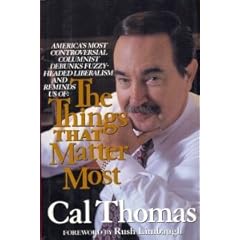
I recently finished reading The Things that Matter Most by Cal Thomas. I’m a sucker for library book sales, and I found this book at a local sale about a month ago.

Thomas wrote this book shortly after Bill Clinton came to office. What I found so interesting was how the author described Clinton as a child of his times, the epitome of the 60s revolution. This would prove even more true than Thomas realized, as Clinton would later be impeached for perjury and obstruction of justice after his sexual promiscuity and disgracing of the Oval Office.

At any rate, I think Thomas does an excellent job of capturing what really went on in the 1960s. When I read David Well’s The Courage to Be Protestant, he said that the private spirituality and rejection of all authority that we see today are deeply rooted in the 1960s. But having not lived during the 60s, I always felt like Wells assumed I knew what he was talking about. Thomas, on the other hand, walks you through that infamous decade and lists some of the distinguishing marks of those times.

Thomas says on p. 3, “To understand why the promises [Baby Boomers] are making to us today won’t work, it is crucial that we examine the promises they made before, which they broke.” These failed promises then set the agenda for the rest of Thomas’ book, as he gives one example after another of how these promises were flawed and have done nothing but wreak havoc in society. Here’s the list:

  • The Promise of Liberation from the Traditional Family
  • The Promise of Unrestrained Expression
  • The Promise of Pharmaceutical Enlightenment
  • The Promise of Sexual Freedom
  • The Promise of God’s Death
  • The Promise to End Poverty
  • The Promise of Preferential Treatment for the Young and Strong
  • The Promise of Progressive Education
  • The Promise that Bigger Government will do it all for You

Sound familiar? These promises of the sixties revolution are still alive and well today, and are still producing the same empty results. They are tied to a worldview that is essentially humanistic and hedonistic, denying the existence of a just, jealous, merciful, and sovereign God who has revealed His nature and His will in the Bible.

Just as Adam and Eve discovered, when we pursue the promises of happiness apart from God, we are eventually in for a rude awakening.

Thoughts on Life and Leadership