
Last week, Natalie and Dylan came up with this creative rendition of the David and Goliath story, using Lego blocks. One of my favorite moments is when David “somersaults” over to the army of Israel.
The Future Reign of Christ
 “Rejoice greatly, O daughter of Zion! Shout in triumph, O daughter of Jerusalem! Behold, your king is coming to you; He is just and endowed with salvation, Humble, and mounted on a donkey, Even on a colt, the foal of a donkey. I will cut off the chariot from Ephraim And the horse from Jerusalem; And the bow of war will be cut off. And He will speak peace to the nations; And His dominion will be from sea to sea, And from the River to the ends of the earth.” (Zech. 9:9-10)
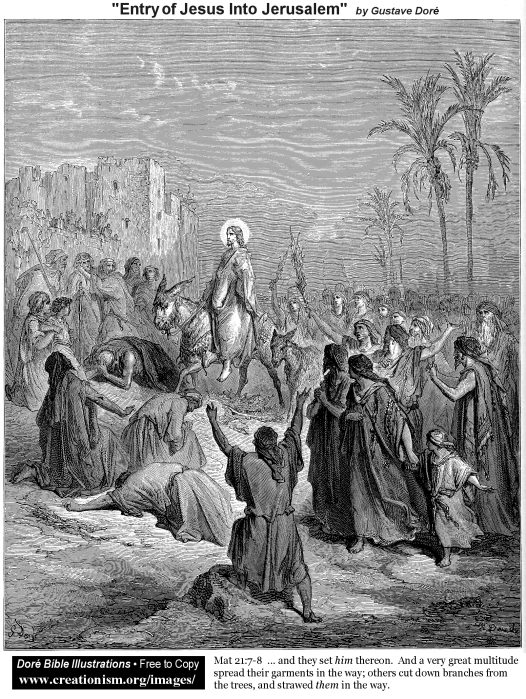
While preparing for Sunday’s message on the “Triumphal Entry” of Jesus Christ, I came across this great quote, which refers to Matthew 21:4-5:
It is noteworthy that Matthew, in explaining the need of a literal colt for the King’s entry, is careful to restrict his quotation to only the first part of Zechariah’s prophecy. Verses 9-10 of Zechariah 9 form one continuous prophecy joined by the conjunction “and.” Verse 9 tells the manner of the King’s arrival, while verse 10 tells what the King will do when His beneficent reign is established. Then the “chariot,” the “battle bow” and the war “horse” will be cut off; He will “speak peace unto the nations: and his dominion shall be from sea to sea, and from the River to the ends of the earth” (ASV). Not one of these details of Messiah’s reign in verse 10 is even mentioned by Matthew. Writing both by divine inspiration and from the vantage point of known history, Matthew knew that the King had arrived and also that the King had not occupied His Messianic throne. If the colt ridden by the King upon His arrival had to be literal, so also must the warfare be literal which will be abolished when He reigns. If Matthew had believed in a “present Messianic reign” ushered in by the first coming of the King, here would have been the time and place to cite in full the details of Zechariah 9:9-10, but He says not a word about the wondrous things of verse 10. (Alva McClain, The Greatness of the Kingdom
, p. 347)
We see something similar in Luke 4, where Jesus stands up in the synagogue and reads from Isaiah 61:1-2a, which He says has been fulfilled in their hearing, during His first advent. But He shuts the scroll and does not read the rest of the prophecy, which mentions vengeance, and pertains to Christ’s future, second coming.
The gospel is not multiple choice
Erich Bridges of the International Mission Board has some good thoughts on Jesus, religion in America, and the implications for global missions. Here’s an excerpt:
“If the Good News (Gospel) of salvation in Christ alone is not true, what’s the point of spreading it? That would be hypocrisy, fraud, false advertising, bogus journalism. The Christian mission stands or falls on the exclusive truth of the Gospel — as does Christianity itself, which has always been a missionary faith.”
Read the whole thing here.
The pride of moral superiority
“There is none righteous, not even one.” (Rom. 3:10)
Last Saturday at Men’s Bible Study, we were made aware of our own pride and selfishness through Jerry Bridge’s book, Respectable Sins.
Bridges has spent thousands of hours studying and writing and preaching and counseling on the matter of personal holiness. So when he speaks about the human heart, I know I need to listen. And what he said about self-righteous pride really grabbed my attention:
I venture that of all the subtle sins we will address in this book, the pride of moral superiority may be the most common, second only to the sin of ungodliness. But though it is so prevalent among us, it is difficult to recognize because we all practice it to some degree. In fact, we seem to get a perverse enjoyment out of discussing how awful society around us is becoming. When we engage in this kind of thinking and conversation, we are guilty of the pride of moral superiority. (p. 90)
I feel way too good about myself. If my thoughts and impulses were carried out and translated into words, I would probably be caught saying things like,
“Thank God I’m not like that murderer, or drug addict, or homosexual. I sure am glad I’m not one of those open theists, or emergents, or charismatics, or Arminians! Come to think of it, I really am a pretty good Christian. I read my Bible more than he does; I arrive to church earlier than she does; I know my theology better than he does; I never struggle with the sin he does; I’m a lot nicer to be around than she is; my prayers are much more fluent than his; my comments are always more profound than hers; I’m a better writer than she is; I’m a better preacher than he is; and I bet I even tithe more than he does. God sure must be happy with me. Isn’t He lucky to have me on His side?”
I’m being only slightly facetious here. In these moments of moral comparison, which are far too frequent, I’m really no better than the Pharisee of Luke 18:11-12. Exalting himself, he was humbled by God, and found no mercy (v. 14).
The remedy to all of this is to fix my eyes completely on Christ. His glory and perfection smash my self-righteousness like a sledgehammer. And when I hear His words, “You shall be holy, for I am holy,” (1 Pet. 1:16), I suddenly realize just how sinful I am, and how much I need the cross of Jesus every day.
Disciplining our children
Discipline. What comes to mind when you hear this word? Harshness? Insensitivity? Perhaps even abuse? In the Bible, ‘discipline’ is consistently portrayed as an act of love. Consider these verses:
Proverbs 13:24 He who withholds his rod hates his son, But he who loves him disciplines him diligently.
Hebrews 12:6 For those whom the Lord loves He disciplines, And He scourges every son whom He receives.”
Hebrews 12:9-10 Furthermore, we had earthly fathers to discipline us, and we respected them; shall we not much rather be subject to the Father of spirits, and live? For they disciplined us for a short time as seemed best to them, but He disciplines us for our good, so that we may share His holiness.
I can testify that as a child, discipline was never “fun.” But I am very thankful that my mom and dad faithfully disciplined me as seemed best to them. Even at the time, I respected them because I knew they did it out of love, and never out of anger.
Now, with children of our own, Natalie and I struggle daily with the matter of discipline. How strict should we be in our rules? When should we be firm? When should we give another warning? And what punishment will fit the crime, so to speak?
I really appreciated these words by Danny Akin, as he recalled how he and his wife raised four godly sons:
In our family we tried to provide a big playing field not a small one. Why? Because kids are kids and, if the box is too small they will break the rules constantly and you will probably not be consistent in your discipline. We always told our boys they would establish the size of the playing field. If they were faithful, truthful and trustworthy, the playing field got bigger and bigger. If they were unfaithful, untruthful and untrustworthy, the playing field got smaller. We also adjusted the way we disciplined as they grew older. We believed spanking, in moderation and always under control, is both biblical and effective when the children are small (e.g. Proverbs 29:15). However, as they grow older, unless the situation is extreme and exceptional, the rebuke and restriction is a more effective way to mold and shape their character and behavior.
 Pinch Of Clay