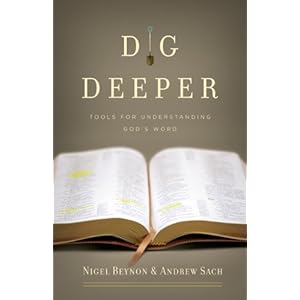
Book review: Dig Deeper

Dig Deeper is truly a gem. It’s one of the best introductions to biblical interpretation I’ve ever read. Written in a fresh, readable style, the authors cover an amazing amount of territory in a very short book.

In the introduction, the authors write, “We want to help you to dig deeper to find hidden riches in the Bible…Pastors and scholars are a gift from God, and we should be grateful for their help. But we shouldn’t be content to leave it entirely to the experts…This book is based on the idea of a toolkit…a set of practical tools to help you get to the bottom of any Bible passage.” They then proceed with 16 different tools, from the Author’s Purpose tool (most important), to the Vocabulary tool; from the Structure tool, to the “So What?” tool.

I’ve heard many people say, “I try to read the Bible, but it’s so hard to understand!” This book could radically improve your Bible study and devotional life. It moves at a rapid pace while not missing weighty concepts. It gives a broad sample of biblical texts and warns of common interpretive errors. One of its greatest strengths is a short exercise at the end of each chapter, and then a brief example of how all the tools work together at the end of the book.

There are two areas that would have made this book even better. First, the authors should have included a full chapter on history and cultural background. They could have called it the “culture tool.” Re-creating the original setting, manners, customs, geography, archaeology, etc. are all a vital part of fully understanding a passage. Secondly, I have to respectfully disagree with their approach to prophecy (p. 107 and 122). They represent a classic covenantal position which misses the unconditional nature of the Abrahamic covenant and departs from the same literal hermeneutic they recommend elsewhere.

But with these 16 practical tools in hand, you can finally dig deeper into God’s Word. Read it. Study it. Enjoy it. And let God radically change your life.

Raised for our justification

According to a 2007 poll by George Barna, 75% of Americans believe in the literal resurrection of Jesus Christ. What amazes me is not that 1/4 of Americans deny the resurrection (we would expect there to be skeptics today, just as there were in the time of Christ), but that 3/4 of Americans say they believe in the resurrection, and yet it makes no difference in most of their lives! For example, I noticed far more media hype about the iPad last week than the empty tomb of Jesus.

But if the tomb really was empty, it should radically alter our lives. Why does Easter matter? Because in Romans 4:25, Paul says that Christ was “raised for our justification.” Without Easter, there is no justification. With Easter, we have the opportunity to be justified of sin. Last Sunday, I posed three questions about justification:

  1. What is it? ‘Justification’ is an idea completely unique to Christianity. It is a legal term that means to acquit or pardon. It speaks not only of absolving guilt, but of being declared righteous by God. In the book of Romans, it serves as a bridge between the early chapters of condemnation (Rom. 1:18; 3:10, 23) and the later chapters of reconciliation (Rom. 5:11; 8:1). Justification is not something we can earn by works, but something we receive through faith. 
  2. What does it look like? In Romans chapter 4, Paul gives us a model of justification by faith. He points us to Abraham, the “father of a multitude.” For many years, Abraham waited on God to fulfill his promises (Gen. 12:1-3), and even when he was old and “as good as dead,” he did not waver in unbelief (Rom. 4:19). Because he trusted in God despite his circumstances, “it was credited to him as righteousness” (Rom. 4:22). In other words, God justified him by faith.
  3. What difference does it make? These things were not written merely for Abraham, but for us as well (Rom. 4:23-24). We have committed a heinous crime (sin). There is a heavy sentence for that crime (eternal death). But God has punished His Son in our place (the cross), and now declares us righteous through faith (justification). It is not enough to intellectually believe in the facts of Christ’s death and resurrection, but to humble ourselves before God for our sin, and to look to the cross as our only means of pardon.

Questions for thought and discussion:

  • What does it mean to be ‘justified’?
  • How do you think Abraham must have felt to wait 25 years for God to keep His promise?
  • Read Genesis 21:1-5. Did God eventually give Abraham a son?
  • Read Romans 3:24 and Romans 5:1. What is the only way a person can be justified? 
  • According to Romans 5:1, what is the result of our being justified?
  • Have you trusted in Christ — not merely in your head, but in your heart?
  • Write a prayer to God, thanking Him for His amazing work of raising Christ for our justification

Sunday’s sermon has been uploaded to our podcast site and is available for free download.

    Rick Warren and the Desiring God Conference

    Last week, it was announced that Rick Warren will be one of the speakers at the 2010 Desiring God Conference. Tim Challies has an excellent post today on the concerns over this decision. His conclusion:

    I believe [Piper] has shown a lapse of discernment in inviting Rick Warren to his conference and onto his platform. And that’s the thing about platforms–once built, they need to be nurtured, preserved and protected. John Piper must know that he is massively influential; this endorsement of Rick Warren ultimately strengthens Warren’s platform and weakens his own.

    …Warren’s critics have not always been fair to him and yet neither have they been without justifiable and significant concerns. His ministry is in so many ways antithetical to Piper’s. It surprises me and maybe disappoints me a little bit that he has been invited to share that platform.

    I recommend Challies’ whole article to understand how he arrives at his conclusion. You may also want to read his original book review of The Purpose Driven Life.

    While Piper’s decision probably was a “lapse in discernment,” there is no sense in us pulling our hair out and separating from Piper or unleashing more vitriol into the blogosphere.

    I suspect that if the Apostle Paul were alive today, he would neither endorse Rick Warren nor spend a lot of time attacking him. Rather, he would probably say something like he did to the Philippians:

    “Some, to be sure, are preaching Christ even from envy and strife [or, we might add, social concerns and evangelistic pragmatism] … What then? Only that in every way, whether in pretense or in truth, Christ is proclaimed; and in this I rejoice” (Phil. 1:15, 18).

    A Lamb Led Forth

    He was oppressed and He was afflicted, yet He did not open His mouth; Like a lamb that is led to slaughter, and like a sheep that is silent before its shearers, so He did not open His mouth.  (Isaiah 53:7)

    Every year at Passover time, hundreds of Samaritans gather on Mount Gerizim for the Samaritan Passover. Yes, that’s right. There’s still a small remnant of Samaritans that date back to Bible times. Their customs look much like they would have two thousand years ago, when the Jews brought sacrificial animals to the altar in Jerusalem to atone for sin.

    I had the privilege of witnessing the Samaritan Passover back in 2000, while studying in Israel. With my own eyes and ears, I witnessed the lambs being led in, the spilling of blood, and the loss of life. It was an unforgettable experience.

    Why did God command such a gory practice in the Old Testament? Because of this timeless principle: the price for sin is death. As the author of Hebrews says, “Without the shedding of blood, there is no forgiveness” (Heb. 9:22). Ultimately, the Son of God Himself would come to earth, take the form of a man, and be slain for our forgiveness. All the sacrifices of the Old Testament pointed to His death on the cross. So on this Good Friday, let us praise the Lamb of God, who took away the sins of the world!

    Here’s a short story I wrote at the time as I considered Passover from a lamb’s perspective…

    …My front left leg has been tied to this fence all morning. What I would do to reach that luscious patch of grass over there! It seems so close, yet so far away. Oh well. Such is the life of a sheep. Maybe I should sleep for a while until my Master comes to feed me…

    …The sun hangs high overhead, and my stomach burns with hunger. I’ve spent the last few hours standing here alone in the courtyard, watching, waiting, squinting through the blinding rays of the sun. An occasional beetle crawls by, or a fly pesters my face, but nothing out of the ordinary. I wish I could return to my flock, my family. Just one week ago, we grazed leisurely along the pastures of Mt. Gerizim. I wonder why were we brought here…

    …It’s mid-afternoon. At last, my weary body can find relief in the shade! But still, no water. Still, no food. Where could my Master be?! I’ve noticed some people gathering nearby, and there’s a distinct scent of excitement in the air. I wonder what’s going on. Oh, how I love surprises!…

    …More people have arrived now, including some bothersome children. I wish these kids would just leave me alone! Half a dozen of them have kept pestering me for at least an hour — jumping, yelling, and stomping, just beyond the reach of my rope. What pitiful creatures. Meanwhile, the men seem to be gathering large olive branches and throwing them into nearby pits…

    …It’s late afternoon, and the men just finished pouring gasoline into the pits. Now they are throwing matches in… Whoa! look at those giant flames! What’s going on?! Could I be in danger, standing here in the corner of the courtyard?…

    …Dusk is imminent. Many more people, robed in white, are flooding the courtyard. Billows of smoke belch out of the fire pits, nearly suffocating me. As if the hunger and thirst weren’t enough, my eyes are now stinging unbearably. A cacophony of human voices crescendo in song, and faintly in the distance, I hear the desperate cry of other sheep… But wait! Who is that approaching?! … Master!! He’s come to deliver me from this nightmare!

    …No, Master! There must be some mistake! Why have you brought me to the edge of this flame? Why do you trap me tightly between your legs? And why do you hold a dagger in your hand?!…

    Equipped for Excellence 2010

    On Saturday, April 17, the Inland Empire Southern Baptist Association will be hosting their annual Equipped for Excellence conference. This is one of the best discipleship conferences in the country for Sunday School and Small Group training.

    This year, I have the privilege of teaching a seminar entitled, “How to Study and Interpret the Bible.” In four and a half hours, you’ll get a crash course in biblical interpretation (hermeneutics) and even get to practice in class what you are learning. The class is designed to help people of all levels, whether you are just doing personal devotional reading or preparing an in-depth Bible Study.

    This is just one of many other options. Full conference details are below. Be sure to register by next Monday, April 5, to get your early bird discount!


    When: April 17, 2010 – 8:30 a.m. to 3:30 p.m.

    Where: Magnolia Avenue Baptist Church and California Baptist University in Riverside , California (map). (Carpooling will be available from First Southern Yucca Valley)

    Cost: $40 per person if your registration is postmarked by April 5th. $45 per person if form is postmarked after April 5th. The registration fee includes a continental breakfast, lunch on site by IN-N-OUT BURGER, and five hours of quality Sunday School instruction! Please note that conferees can also have lunch at the Alumni Dining Commons at CBU!

    Keynote Speaker: Pastor Calvin R. Wittman of Applewood Baptist Church in Wheat Ridge , Colorado

    Conferences Available: Below you’ll find a list of all the conferences offered, or you can view a Word document with the full descriptions.

    FOR POTENTIAL TEACHERS

    Training Potential Sunday School Workers (Tom Belew)

    FOR PRESCHOOL

    Babies and 1 & 2 year olds (Lynae Dacus)
    Three-Year Olds through Pre-K (Landry Holmes)
    Kindergarten (Ann Iorg)
    Using Visuals in Teaching (Lorie Honeycutt)
    Working With Special Ed (Pamela Robinson)

    FOR CHILDREN’S MINSTRY TEACHERS

    Younger Children (Carol Bohrer)
    Middle Children (Karen Massingill)
    Older Children (Judy Latham)
    Using Visuals in Teaching (Lorie Honeycutt)
    Strengthening Your Children’s Ministry (Cathy Hopkins)
    Guiding Children’s Behavior in Sunday School (Cheri Dempsay)
    Working With Special Ed (Pamela Robinson)

    YOUTH MINISTRY

    Junior High (Cheryl Belew)
    Senior High (Mike Lovato)
    Strengthening Your Youth Ministry (Daryl Watts)
    Youth Outreach and Ministry (Mike Kell)
    Youth Developmental Characteristics and Teaching Methodology (Rob Signs)
    Using Visuals in Teaching (Lorie Honeycutt)
    Working With Special Ed (Pamela Robinson)

    ADULT MINISTRY

    Single Adults (Rick Brady)
    Young Adults (Jason Hayes)
    Middle Adults (Alan Raughton)
    Retired Adults (David Apple)
    Care Group Leaders (Janice Holcomb)
    Using Visuals in Teaching (Lorie Honeycutt)
    Working With Special Ed (Pamela Robinson)

    SMALL GROUPS

    Small Group Ministry for New Church Starts (Don Overstreet)
    Enlistment and Training of Small Group Leaders ( Orlando Alonso)
    Dealing with Problems in Your Small Group Ministry (Neil Christopher)

    GENERAL LEADERSHIP

    Pastor’s Conference (Calvin R. Wittman)
    Outreach (Tim Holcomb)
    Assimilating New Members (Randy McWhorter)
    Pastors & Sunday School Directors (small Sunday Schools) (Larry Vowell)
    General Officers (George Yates)
    Strengthening Your Children’s Ministry (Cathy Hopkins)
    Strengthening Your Youth Ministry (Daryl Watts)
    Youth Outreach and Ministry (Mike Kell)
    Youth Developmental Characteristics and Teaching Methodology (Rob Signs)

    SPECIALTY

    Using Visuals in Teaching (Lorie Honeycutt)
    How to Study and Interpret the Bible ( Stephen Jones )
    The Bible’s Most Fascinating People (R. P. Nettelhorst)
    Valuing Volunteers (Katherine Gooden)
    Care Group Leaders (Janice Holcomb)
    Working with Special Ed (Pamela Robinson)
    Guiding Children’s Behavior in Sunday School (Cheri Dempsay)
    Leadership in the Transformational Church (Bruce Raley)
    Biblical World View (Greg Harris)
    The Genesis of Creation (Bill Peters)
    500 Lost Years (Richard Mobley)
    Making Disciples in Your Adult Sunday School Class (Roger Byrd)
    Developing a Strategy Plan for Your Church (Mike McGuffee)
    Using Technology in Your Church (Bobby Gilstrap)
    The Bad Economy: Your Best Friend (Bruce Hitchcock)

    Thoughts on Life and Leadership